Tampilkan postingan dengan label German. Tampilkan semua postingan

Selasa, 29 Juni 2010

BMW M5 "Hans Nowack Edition"


Nowack Motors have released an upgrade package for the BMW M5 which was dubbed as the Hans Nowack Edition to honor the retirement of the M V10 engine. The cars upgrades are mainly in the engine compartment but this modified M5 also received a couple of styling changes such as two bespoke air collectors painted to match the exterior color.

Named the N635S 5.8 Hans Nowack Edition, the 5.0L V10 pushes out 718-hp over the factory 507-hp and revs up to 9000 rpm. This engine conversion is available for all the M5s and M6s sporting the 5.0L V10, and Nowack offers a 12 month warranty with no mileage constraint for those opting to have the work done. So while BMW is pushing ahead with their twin turbo setups and abandoning the joy of torque-heavy V10s, Nowack motors continues to embrace and give current owners a new option to compete with the new technology.

Since the HNE is just an engine makeover, all current M5s / M6s can be converted into a N635S 5.8 Hans Nowack Edition. Furthermore, since every engine is brand new after conversion, the company offers a 12 month warranty without a kilometer limitation.

Source: Nowack Motors


BMW M5 Hans Nowack Edition BMW M5 Hans Nowack Edition BMW M5 Hans Nowack Edition BMW M5 Hans Nowack Edition BMW M5 Hans Nowack Edition BMW M5 Hans Nowack Edition BMW M5 Hans Nowack Edition


Press Release

A farewell celebration for the naturally aspirated V10 masterpieces of the BMW M GmbH: NOWACK MOTORS created a world unique state-of-the-art masterpiece to celebrate the end of the era of high revving naturally aspirated BMW M engines, the N635S 5.8 "Hans Nowack Edition", offering an unmatchable maximum power output of 718hp at 9.000rpm.

NOWACK MOTORS, the world's no. 1 specialist company for engineering and manufacturing unique high performance engines on basis of all BMW M engines (4-, 6-, 8- and 10-cylinder) unveils a world unique naturally aspirated masterpiece, the N635S 5.8 "Hans Nowack Edition".

The N635S 5.8 is a tribute from Oliver Nowack to his father Hans, creator of world famed race and road engines and one of the inventors of what is nowadays called ECU-Tuning. Hans Nowack was an overall technical genius who always had his own approach when engineering and building high performance engines, resulting in numerous glorious victories of his cars in international motorsports, like e.g. the victory of the European Touring Car championship with a BMW 635CSi with driver Helmut Kelleners. He never stopped to invent world-class high performance engines, and after his active career, he continued to be a mentor for his son Oliver, who followed him in his footsteps most successfully. Hans Nowack died in 2005, and Oliver created this engine to pay tribute to the lifework of his father.

It definitely is the pinnacle of all high performance engines ever built on basis of the M GmbH's 5.0ltrs. V10 offering a standard maximum power output of 507hp.

Classic mechanical tuning techniques, the usage of the latest, most advanced coating materials and techniques combined with a most sophisticated, individual remap of the ECU were always NOWACK MOTORS' no. 1 choice when increasing power and torque of naturally aspirated engines, further enhancing the thrill that only a naturally aspirated high performance engine provides. Forced induction, neither by supercharging nor turbo charging, never was an option to increase the performance of the 5.0ltrs. V10 engine as it does not suit the engine's overall technical layout and characteristics. Furthermore, a forced induction engine based on a NA engine never offers the refinement and reliability of a perfectly engineered and manufactured naturally aspirated high performance engine. Thus, it is the ultimate challenge for every high performance engine manufacturer.

Each NOWACK MOTORS N635S 5.8 ?Hans Nowack Edition" is equipped with two NOWACK MOTORS bespoke intake air collectors with a higher air volume in order to provide the engine with sufficient intake air quantity.

The colour of the paintwork for the air collectors is being determined by the exterior colour of the car.

Only this time, the name differs from all other NOWACK MOTORS creations. The name does not reveal the actual maximum power output of the engine, clearly separating this unique showcase of highly sophisticated manufacture of internal combustion engines from the N700 4.8 with 715hp, the latest high performance engine creation based on the new 4.4ltrs. BMW M Biturbo V8 engine of the new era being used in the X5M and X6M. As we all know, this engine will be used to propel the upcoming new M5 of the F10 series by next year.

All internal parts of the engine are being replaced by NOWACK MOTORS' high performance parts, thus every M5/M6 (also cars with a higher mileage), can be converted to a NOWACK MOTORS N635S 5.8 "Hans Nowack Edition".

As every engine is brand new after the conversion, NOWACK MOTORS provides an engine warranty of 12 months without kilometer limitation.

Please visit NOWACK MOTORS' website at: www.nowack-motors.com for further informations.

Jumat, 16 April 2010

Porsche Panamera Black Edition by Techart


The Porsche specialists from TECHART have unveiled today the TECHART Porsche Panamera Black Edition. a new individualization program for the Porsche Panamera. The black matt exterior is complemented by an Aerodynamic Kit I, multifunctional daytime running lights system in black and the exhaust system.

Considering that in many cultures the colour black symbolizes individuality, autonomy and experience the Techart Porsche Panamera Black Edition received a completely matt black exterior along with a set of 22 inch TECHART Formula II light alloys that also painted black.

In the terms of interior ambience, the brand’s designers have restyled the Panamera Turbo’s cabin with black top-end leather and alcantara as well as hand-sewed decorative stitching and leather piping in flamenco red. Moreover, all interior components like trims, door entry guards, cup holder or air vents present themselves in a premium matt black painted design.


Techart also prepared the Carbon Kit matt black, which includes dashboard trims, door panel trims and center console at front and rear. And to further demonstrate they thought of every detail, Techart also offers custom floor mats in black.


TechArt Panamera Black Edition TechArt Panamera Black Edition TechArt Panamera Black Edition TechArt Panamera Black Edition TechArt Panamera Black Edition TechArt Panamera Black Edition TechArt Panamera Black Edition TechArt Panamera Black Edition TechArt Panamera Black Edition TechArt Panamera Black Edition


Press Release

TECHART Black Edition


Black - the most dominant of all colors. In various cultures of the world, it symbolizes characteristics such as individuality, independence and experience - concepts that characterize TECHART and its customers. Reason enough to put the combined experience and individuality from TECHART to work in order to give the Panamera a unique appearance - the TECHART Black Edition.

The Panamera captivates with its exterior kept entirely in matt black. From the TECHART Aerodynamic Kit I to the multifunctional TECHART daytime running light system in black and the TECHART exhaust system, all exterior components across the board merge equally seamlessly into the matt black design. Just the red TECHART logotype gleaming through the spokes of the sporty TECHART 22-inch Formula II light alloy wheels provides a point of contrast in the deep black and powerful appearance of the four-seater.

In the vehicle interior, the Black Edition also does credit to its name. Materials of the highest quality reflect the individual design of the exterior also in the internal space of the Panamera. Finest black leather combined with alcantara as well as hand-sewed decorative stitching and leather piping in flamenco red let the driver feel the impressive TECHART character. In addition, all interior components like trims, door entry guards, cup holder or air vents present themselves in a premium matt black painted design. Quality and precision in every detail - typical TECHART.

Rabu, 31 Maret 2010

New York Auto Show: 2011 Mercedes SLS AMG GT3


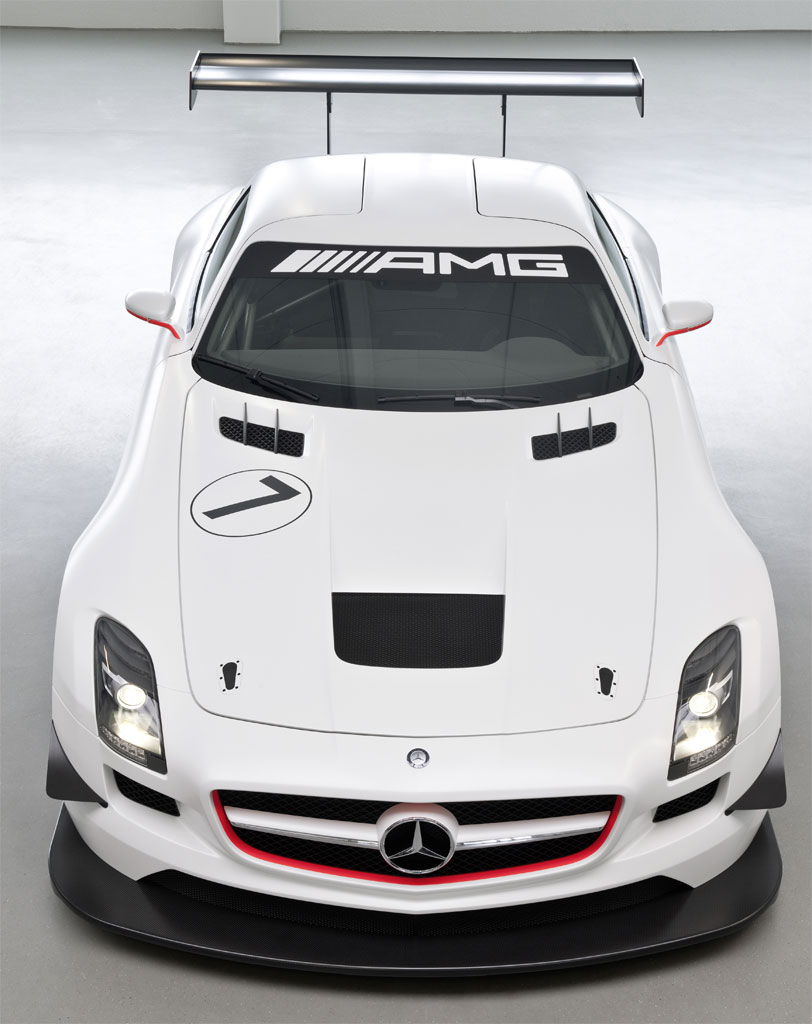
Mercedes-Benz introduced a new race car during the New York Auto Show earlier today.  The Mercedes-Benz SLS AMG GT3 will be used in competition beginning in 2011.

The 2011 Mercedes SLS AMG GT3 is powered by the AMG 6.3-litre V8 front-mid engine with dry sump lubrication coupled with a sequential six-speed racing transmission steering wheel shift paddles. The 2011 Mercedes SLS AMG GT3 also comes with an multi-disc locking differential integrated in the
transmission. The engine and the transmission of the 2011 Mercedes SLS AMG GT3 are connected via a torque tube within which a carbon-fiber shaft rotates at the engine speed, as in the roadgoing version.

The SLS AMG GT3 features a new new front apron with a splitter, the bonnet with central cooling air vent, wider front and rear wings, sideskirts with cooling ducts for the rear brakes, a rear diffuser and the adjustable rear aerofoil.

That light-weight body is made entirely of carbon fiber, with impressive new aerodynamics including a massive front splitter, rear diffuser and enormous rear spoiler. Compared to the road car, the GT3’s bodywork is two inches wider, enough to accommodate some massive center locking 18×12-inch front and 18×13-inch rear wheels with racing slicks. Inside those wheels is a special composite AMG race braking system with six-piston front calipers and four-piston rear calipers.

The 2011 Mercedes SLS AMG GT3 price was not announced yet, but Daimler mentioned that sales will start in autmun 2010.


Mercedes-SLS-AMG-GT3 Mercedes-SLS-AMG-GT3 Mercedes-SLS-AMG-GT3 Mercedes-SLS-AMG-GT3 Mercedes-SLS-AMG-GT3 Mercedes-SLS-AMG-GT3 Mercedes-SLS-AMG-GT3 Mercedes-SLS-AMG-GT3 Mercedes-SLS-AMG-GT3 Mercedes-SLS-AMG-GT3 Mercedes-SLS-AMG-GT3 Mercedes-SLS-AMG-GT3


Press Release

Automobile fascination paired with spectacular race car design - that is the new Mercedes-Benz SLS AMG GT3. The racing version of the SLS AMG has been conceived as a customer sport vehicle for participation in race series based on FIA GT3 regulations. Meticulous lightweight construction and optimized chassis, brakes and aerodynamics deliver uncompromising dynamics. The extra special SLS AMG will make its race track debut in 2011.

The clean design and breathtaking form of the SLS AMG have been effectively accentuated by targeted modifications to the bodyshell. The new components, made largely from lightweight carbon fiber offer a clear indication of extraordinary race track performance and extensive aerodynamic development work.

From the front, the GT3 race car boasts a new front skirt with enlarged air intakes. The wide opening beneath the characteristic radiator grille bearing the large Mercedes star and the wing-shaped horizontal fins supplies air to the engine oil cooler and brake discs. The same function is served by the two intakes below the vertical bi-xenon headlamps. Downforce on the front axle is provided courtesy of four externally mounted side flics, as well as a carbon front splitter; it runs directly into the smooth underbody panel, which connects to the rear diffuser.

The hood features a central opening for the extraction of heat from the engine, while side openings in the front fenders facilitate air flow through the wheel arches. Weight optimization measures include the application of extremely lightweight polycarbonate for the side and rear windows and, if desired, for the front windshield as well.

The fenders have been widened front and rear to accommodate the large racing tires. With a breadth of 78.3 inches, the GT3 bodyshell is a good 2 inches wider than the series production SLS AMG. The new sills feature openings for cooling the rear brakes, with the smooth underbody visible along the underside of the sills. The B-pillar houses the standardized fuel tank adapter for the rapid refueling system. The 31.7 gallon fuel tank is located centrally behind the driver.

Wide rear carbon spoiler

The rear view of the SLS AMG GT3 is dominated by its imposing width. Above the rear hatch sits a wide carbon fiber spoiler; it is extensively adjustable and facilitates perfect setup to suit individual race track characteristics. The new rear skirt accommodates two openings for extracting air from the rear wheel arches. A further visual highlight is the rear carbon fiber diffuser; it rises smoothly from the rear axle area as a continuation of the smooth underbody, its form adding to the downforce. The overall aerodynamic concept of the SLS AMG GT3 was analyzed and defined through extensive wind tunnel and race track testing.

The black exhaust end pipes deliver a fascinating and, at the same time, characteristic AMG eight-cylinder sound. The regulation rain lamp is integrated into the rear hatch - it must be switched on by the driver in poor weather conditions.

Close to series production AMG 6.3 liter V8 engine

As defined in the FIA GT3 regulations, the AMG 6.3 liter V8 engine is virtually identical to that of the series production vehicle. Thanks to its low weight, the acceleration figures for the GT3 - 3.7 seconds for the sprint from 0 to 60 mph - are considerably below the already excellent figures for the series production vehicle. Depending on gear ratio, the top speed is more than 186 mph.

The AMG 6.3 liter V8 engine uses dry sump lubrication in the racing vehicle, too. The application of a suction and pressure pump, as well as an external oil tank means that the conventional oil sump can be omitted. This technology ensures reliable lubrication of the engine under high lateral acceleration, of the kind usually experienced on the race track.

Dry sump lubrication also facilitates a low mounting position for the V8 power unit - one of the key technological highlights of the SLS AMG. The solution - installing the eight-cylinder as low as possible and as a front mid engine behind the front axle, combined with a transaxle transmission layout - results in excellent weight distribution.

Six-speed racing transmission with sequential shift

In contrast to the series production vehicle, the SLS AMG GT3 is equipped with a six-speed racing transmission with sequential shift. Thanks to its compact construction, the race-tested transmission offers considerable packaging benefits - ultimately, the GT3 version has less ground clearance than the series production vehicle. The driver shifts gear using two shift paddles on the steering wheel. The transmission is mounted directly on the rear axle and connected to the V8 engine via a torque tube, which has a very high degree of flexural and torsional stiffness. This delivers considerable benefits when it comes to dynamics, as this sophisticated solution enables the entire driveline to be laid out with significantly less play. Alongside the traction control, a multi-plate locking differential integrated into the transmission delivers outstanding acceleration characteristics. Inside the torque tube, a drive shaft rotates at engine speed. As in the series production model, and in the Mercedes-Benz C-Class DTM touring car, the shaft is made from carbon fiber.

With its long wheelbase, low center of gravity and wide track, the SLS AMG vehicle concept was predestined for the race track - its strengths include precise turn-in characteristics, first-class agility, low inertia under sudden changes of direction and a high cornering limit.

It required only minimal modification for perfect race track performance. The lightweight aluminum chassis with double wishbone suspension at all four corners has modified kinematics to take into account the lower vehicle height. The array of adjustability options facilitates optimal modification to suit individual race track characteristics and varying weather conditions. As well as the ability to vary the spring and damper setup, there is also the freedom to adjust track and camber, vehicle height and the stabilizers on the front and rear axles.

Like the series production SLS AMG, the GT3 version is also equipped with rack and pinion steering with speed-dependent power assistance. The more direct input ratio facilitates even greater handling agility on the race track.

AMG race braking system using composite technology

Shortest stopping distances, highest stability and optimal control are guaranteed by the AMG race braking system. All four corners feature brake discs in motorsport-tested composite technology. Gray cast iron axial and radial floating discs are fixed to an aluminum hat via stainless steel composite elements. This sophisticated technology enables perfect heat dissipation and thus reliable stability. The SLS AMG GT3 is also equipped with precisely calculated cooling channels - openings in the front skirt and ahead of the rear wheels direct cool airflow over the brake discs. All four brake discs are ventilated, slotted and drilled. Six-pot fixed calipers on the front axle and four-pot fixed calipers at the rear, finished in anthracite with the AMG logo in white, provide plenty of brake pad surface. An anti-lock brake system with special race track settings is fitted as standard. Due to space restrictions, the AMG high-performance ceramic composite brake system, available as an option on the series production vehicle, is not compatible with the 18-inch wheels prescribed by FIA regulations.

The AMG center-locking alloy wheels - 12x18 inches front and 13x18 inches rear - are fitted with racing tires in formats 11.3 x 26.9 inches (front) and 12.4 x 27.9 inches (rear). Depending on the application, the tires are available as profile-free slicks, intermediates or wet weather tires. The classic multi-spoke design aids ventilation of the braking system. Fast pit stops and wheels changes are ensured by the pneumatic lift system integrated into the underbody. Four pneumatic rams raise the GT3 race car by around 7.5 inches, enabling the pit crew to change the racing tires in double quick time.

Interior with racing bucket seat and race steering wheel

On opening the gullwing doors, the SLS AMG GT3 displays a functional interior with a distinctly race car feel. The driver sits in a racing bucket seat fitted with a six-point harness and the HANS system (Head and Neck Support) that fixes the helmet in place in the event of an accident, thus minimizing the risk of injury. Additional safety comes courtesy of the steel roll cage, which also serves to further stiffen the aluminum spaceframe.

A steering wheel with a diameter of 13 inches facilitates perfect vehicle control. Because it is open at the top, the driver always has a perfect view of the central display, which provides all relevant information such as road speed, engine speed, operating temperatures, lap times and gear selection. The steering wheel is fitted with a quick-release mechanism that makes entering and exiting the vehicle considerably easier. The switches on the steering wheel hub enable the driver to activate additional functions such as the pit radio, headlamp flasher and the drink supply. Further operating elements are mounted on the center console and include the start/stop function for the AMG V8 engine, the traction control, reverse gear and - just in case - the integrated fire extinguisher. The control for adjusting brake balance is located on the torque tube tunnel.

The close relationship between the GT3 and its series production sibling is demonstrated by the instrument cluster, with its powerfully taut wing profile providing visual breadth. Integrated into the dash are the highly distinctive air vents galvanized in "Silver Shadow" and with adjustable cross-shaped nozzles - their form evocative of a jet engine.

Deliveries of customer vehicles to start early 2011

The new SLS AMG GT3 has been developed in accordance with FIA GT3 regulations and is entitled to participate in all GT3 race series - including the popular 24-hour races in Spa-Francorchamps, Belgium, and on the Nürburgring in Germany. Interested customers can order the vehicle starting in autumn 2010, with delivery scheduled prior to the start of the 2011 racing season. Homologation will be completed in March 2011.

Jumat, 26 Maret 2010

Video: BMW Technik Think Tank Celebrates 25 Years of Concepts


BMW Technik is the BMW Group’s research subsidiary that put simply works on the future. They step back from the day to day task of designing and building the next BMW and MINI models and focus on research and engineering at a level that’s simply not possible normally. And since the introduction of Technik 25 years ago the group has created show stopping engineering mules, concepts and even a few production components and full on cars. So with that said BMW is celebrating today with an enormous amount of photos and press releases meant to give you the full run-down on what Technik has done over the past 25 years. With it we also present you an incredible gallery of photos some of which are seen here for the first time.

via:bimmerfile


Press Release

Source of innovation. 25 Years of BMW (Forschung und) Technik GmbH.


Innovative force entails future capability. The BMW Group owes its status as the world's most successful manufacturer of premium automobiles to an outstanding development concept in all areas relevant to driving pleasure, sustainability and safety. The principles of this pre-eminence have been forged over the last quarter of a century in BMW (Forschung und) Technik GmbH. The researchers operating within the framework of this think tank develop technologies and concepts for individual mobility in tomorrow's world. The subsidiary was created 25 years ago as BMW Technik GmbH. With this company the BMW Group has a centre of competence that is unique throughout the world. It safeguards and expands technology leadership for BMW by providing a constant stream of innovations.

This groundwork is carried out autonomously, but it is by no means uncoupled from the development of series vehicles. The experts working in BMW Forschung und Technik GmbH enjoy a high degree of creative freedom that allows them to take innovative approaches and look for unconventional solutions. They make use of diverse sources of inspiration which can range
from bionics to space engineering, and they develop perspectives on the future that extend far beyond the life cycle of a vehicle model. "Our project-related research is not linked to the current product range, although we naturally have the objective of consistently optimising the characteristic features of vehicles coming from the BMW Group and transferring our projects and ideas to series development," explains Professor Raymond Freymann, Managing Director of BMW Forschung und Technik GmbH.

The concept of cooperative research also ensures that the departments responsible for subsequent series development can be integrated within the relevant project at an early stage. This approach guarantees that operations for realisation are already being monitored during the research phase. The initiators of an innovation also support their project after it has been transferred to the pre-production and series development phase. They then move with their project to the series development department at BMW AG. This provides safeguards for ensuring that information is not lost at interfaces, and it promotes a dynamic exchange of ideas on a personal level between research and series development. This strategy facilitates a strategic and efficient use of the innovative force pooled within BMW Forschung und Technik GmbH.

Competence centre in Munich and international network.

The subsidiary company was founded as BMW Technik GmbH in 1985. The main focus of activities in the early years was defined as the development and construction of concept vehicles. The minutes of the Executive Board meeting in January 1985 clearly set out the mission of the fledgling company: "The recently founded company BMW Technik GmbH has the mission to develop innovative, future-oriented and original overall vehicle concepts and sub-concepts away from the constraints of a specific series workflow schedule. However, the objective should always be to develop solutions that have the potential for series development." The initial aim was to work on projects under the working title "Auto 2000" and "Local Vehicle".

When the company was rebranded in 2003 as BMW Forschung und Technik GmbH to reflect both research and technology, the focus was shifted to developing technology that encompassed all types of BMW vehicle. The workforce currently has a headcount of around 200 at the Munich site, and BMW Forschung und Technik GmbH has extensive expertise in the areas of vehicle engineering, hydrogen technologies, alternative drive and energy management concepts, active safety and driver assistance systems, as well as information and communication technologies in the vehicle. The research and technology centre also maintains centres in the USA: the Technology Office Palo Alto in Silicon Valley, California, and the Liaison Office Clemson, South Carolina. They enjoy a close relationship with universities such as Stanford University and the Massachusetts Institute of Technology, as well as research institutes and high-tech companies in other sectors. The aim is to harness innovative trends and technologies for deployment in the automobile sector.

There is also an extensive exchange of ideas with universities and research institutes at German and European level. Participation in the Eurécom European communication network - based at the Sophia Antipolis high-tech centre in southern France - ensures that the research subsidiary of the BMW Group has access to leading-edge information and telecommunication technologies. In addition, BMW Forschung und Technik GmbH has a base at the German Research Centre for Artificial Intelligence and drives forward the automation of intelligent behaviour and hence the "Automobile of the Future".

The Munich Center of Automotive Research (CAR@TUM) established as a joint venture with Munich Technical University gives the subsidiary of the BMW Group permanent access to high-flying young academics with great potential for the future and it also ensures access to important results derived from ground-breaking scientific research.

BMW Forschung und Technik GmbH also works on state-financed research projects at national and international level together with other automobile manufacturers and suppliers in order to create industry-wide standards, ultimately for the benefit of all customers. One of the latest examples of this work are the field trials for vehicle-to-vehicle communication in the project entitled "Safe mobility - Test bed Germany", abbreviated to simTD.

Anniversary: Premiere for fascinating concept vehicles and pioneering technologies.

The history of BMW Forschung und Technik GmbH has been defined by a long track record of concept vehicles and technological innovations which generated pioneering impetus for the development of series vehicles, components and systems. The influence of research projects exerts varying effects on series development, depending on the subject focus and complexity. The scope ranges from direct implementation in the form of a concrete project to long-term development of technology competence. BMW Group Research and Technology is presenting a selection of projects to celebrate this landmark anniversary. The specialists working at the centre have developed these projects and some of them will be experienced for the first time outside the confines of the well-guarded laboratories and workshops.

One of the first projects to be launched by the fledgling subsidiary company was the prototype for a BMW Z1 Coupé developed in 1988. This vehicle was created within the framework of a concept development based on the very first project of the new subsidiary - the BMW Z1 roadster produced in a limited series. The development engineers were interested in methods and technologies to facilitate a maximally efficient extension of a vehicle concept to additional derivatives. The knowledge gained from this project was used for the BMW Z3 series model, which was produced as a roadster and coupé, and for the first generation of the BMW Z4, which was also manufactured in open-top and closed versions.

A fuel-cell hybrid vehicle based on the BMW 1 Series is another project being presented in the public domain for the first time. This project developed by BMW Forschung und Technik GmbH shows a highly innovative form of hybrid technology developed within the framework of Efficient Dynamics in conjunction with the use of hydrogen as a fuel. Alongside a four-cylinder petrol engine, the research vehicle has an electric power unit for city traffic. The electrical energy is generated by a small fuel cell in the form of an Auxiliary Power Unit (APU) and stored temporarily in high-performance capacitors. These so-called super caps cover the performance peaks for acceleration and taking off at traffic lights, and store the electricity generated during braking. Using a comparatively small fuel cell to generate electricity from hydrogen achieves a high level of efficiency for city traffic, while the internal combustion engine is only used for high-speed journeys. This combination could have the capability to provide an emission-free range of several hundred kilometres in city traffic and facilitate "recharging" within the space of a few minutes - this is in addition to the mobility reserves provided by the internal combustion engine for long-distance travel.

BMW Forschung und Technik GmbH is also celebrating its anniversary by providing a unique insight into innovative projects in the area of intelligent networking between driver, vehicle and environment. BMW ConnectedDrive already delivers a package of driver-assisted systems and mobility services that is unique throughout the world. These systems enhance comfort and safety, as well as optimising infotainment functions in the vehicle. The current research projects in this area include the narrow-passage assistant, which assists drivers if they are driving along particularly narrow lanes, for example near building works, and the emergency stop assistant which brings the vehicle safely to a stop if there is a medical emergency.

The latest success of the joint venture between BMW Forschung und Technik GmbH and Munich Technical University (CAR@TUM) is also presented. The project "IT-Motive 2020" involves the researchers developing an innovative architecture for information and communication technology integrated within the vehicle that permits functions previously distributed over a large number of different control units to be pooled in a homogeneous communication network. The aim is to provide a consistent hardware platform for displaying the continually expanding number of vehicle, comfort and safety functions.

Milestones: from the BMW Z1 to the lightweight sports coupé BMW Z29.

BMW Technik GmbH was launched in 1985 with the mission to develop innovative solutions for a large number of aspects associated with individual mobility. The specialists working in the newly established department were able to get to grips with this mission successfully in the very first project they tackled. They developed the BMW Z1 roadster. This vehicle project was intended to trial innovative materials, launch a revolutionary bodywork concept, and highlight opportunities for optimising development processes.

The result was so impressive that already three years later the first out of a total of 8 000 series vehicles left the Munich BMW Plant. With its plastic body, vertical sliding doors and fascinating handling properties, the BMW Z1 was not simply the first milestone in the history of BMW Technik GmbH - it also made its mark as an exceptional phenomenon on the road.

Revolutionary body and power-unit concepts were to shape development operations during the years to come. In 1993, the BMW Z13 was presented, a compact vehicle with a sporty design powered by a rear-mounted engine and three seats in an unconventional configuration. The driver was positioned behind the centrally located steering wheel, with seating space being provided behind the driver for two passengers. The study featured the driving pleasure typical of the brand, a high level of comfort, and outstanding safety attributes.

BMW E1: pioneer for electro-mobility.

The same year already saw BMW Technik GmbH presenting the BMW Z15. This first fully functional concept vehicle with pure electric drive was a development of the BMW Z11 electric vehicle presented at the Frankfurt Motor Show in 1991. As a prototype with the model designation BMW E1, the four-seater incorporated a design with pioneering aerodynamic and
ergonomic features that provided impressive testimony to the superlative potential of its emission-free drive technology even in normal everyday use. The BMW E1 provided a range of up to 200 kilometres and a top speed of 120 km/h. The prototype generated universal acclaim among members of the public and independent testers. The readers' choice in car magazine "Auto Zeitung" voted the BMW E1 as the winner in the category "Environment and Technology", and trade magazine "Auto Bild" described the BMW E1 as "the most advanced car of the century".

At the time, it was already evident that BMW was in a position to achieve typical BMW driving characteristics and operational capability geared to city driving with a purely electrical power unit. Series development would also be achievable if a battery technology with optimised power and cost could be developed. Today, BMW is continuing to build on this knowledge base in the context of project i: it provided the impetus for the development of a Mega City vehicle designed for emission-free mobility within large urban environments. An innovative vehicle concept and the most recent developments in the area of power unit and energy storage technology form the basis for a state-of-the-art presentation of electrical mobility.

New routes to maximum driving fun: BMW Z18 and BMW Just 4/2.

The development of the prototypes launched in 1995 also saw the specialists at BMW Technik GmbH searching for new and sophisticated approaches to driving pleasure. One of their ideas focused on designing an automobile counterpart to the Enduro motorcycle concept that was so successful during the 1990s. The yearning to explore off-road terrain and the pleasure of mobility under the open skies was combined for the first time on four wheels in the BMW Z18. An eight-cylinder engine, four-wheel drive, a variable interior concept and elevated seating characterise the innovative driving experience in the robust roadster.

The BMW Z18 had to wait five years after it was created for its public debut - the occasion was the celebration of 15 years of existence for the think tank. Another prototype that offered the prospect of driving fun while having previously been confined to motorcycles captivated the driving public at the Tokyo Motor Show in Japan as early as 1995. Freestanding wheels, a body that abandoned roof and windscreen, and a rear-mounted four-cylinder engine packing 100 hp were the hallmarks of the study where the two-seater concept was already integrated in the model designation - BMW Just 4/2.

Festival of innovations: The BMW Z22.

The BMW Z22 was among the most sophisticated technology platforms that BMW Technik GmbH ever created. The study was presented in 1999, and it bristled with no less than 70 innovations and 61 registered inventions in areas ranging across body concept, lightweight construction, power unit, safety, mechanical systems and controls. The use of carbon-fibre reinforced plastic in an innovative processing procedure permitted compliance with the highest crash safety standards while at the same time significantly reducing weight. Power steering, an electromechanical braking system, cameras instead of wing and rear mirrors, and a cockpit design reduced to the bare essentials defined the mould-breaking, future-proof character of the BMW Z22. Adaptive headlights, Head-up Display and central control unit enabled the prototype to offer innovative functions that were soon implemented further down the line in BMW series vehicles.

Consistent lightweight construction for uncompromising driving pleasure: The BMW Z29.

Optimization of the vehicle weight by deploying the most advanced high-tech materials was the focus of development for the BMW Z29 concept study. The prototype of a two-seater sports car was completed by BMW Technik GmbH in 2001 and represents the culmination of cooperation with another subsidiary of the BMW Group - BMW M GmbH. The vehicle exerts
fascinating appeal with flowing lines and lambo-style doors. The principles underlying the outstanding potential of the BMW Z29 for dynamic driving can be found under the engine bonnet and below the surface of the paintwork. The power was generated by the in-line six-cylinder engine of the BMW M3 - at that time a technological benchmark - and the passenger cell was manufactured from carbon-fibre reinforced plastic while the rear axle, and front and rear module were designed in aluminium. The most important results of this combination: a weight-to-power ratio of 3.4 kg/hp and an acceleration ratio of 4.4 seconds for the sprint from a standing start to 100 km/h.

Research as foundation for Efficient Dynamics.

The Efficient Dynamics development strategy provides the BMW Group with the world's most efficient programme for reducing consumption and emission values in road traffic. The development of power systems with optimised efficiency, smart energy management in the vehicle, and aerodynamic measures form the key supporting aspects of this strategy, complementing lightweight construction throughout. BMW Group Research and Technology has made significant progress in all these areas since the company was established and the results have been channelled into the series development of many different new models.

Intensive fundamental research has also been carried out in the context of the development of innovative and alternative propulsion systems. The spectrum of research ranges from new concepts for the classic internal combustion engine, through hybrid technology and the deployment of hydrogen as a fuel in the vehicle, to electro-mobility. This demonstrates that research covers all the areas that today form the mainstays of the Efficient Dynamics development strategy.

Hybrid concepts: more efficiency, more driving pleasure - right from the start.

The BMW ActiveHybrid 7 and the BMW ActiveHybrid X6 are the first two models of the brand available in 2010 to use a combination of internal combustion engine and electric motor. Each model deploys a unique platform of BMW ActiveHybrid technology while also presenting a characteristic homogeneity: BMW ActiveHybrid presents tangibly enhanced dynamic
driving accompanied by significantly reduced consumption and emission values. This twin-track advance is manifested in the BMW EfficientDynamics development strategy, and from the start it shaped the ground-breaking work carried out by BMW Forschung und Technik GmbH in hybrid technology. Hybrid technology in the style of BMW advances efficiency and intensifies driving pleasure.

The hybrid concept car based on the BMW 5 Series and developed in 1994 already facilitated fully electric and hence emission-free driving with characteristic features optimised for city traffic. The car's power-unit technology configured as a parallel hybrid drive combined a four-cylinder petrol engine with an electric drive which generated a maximum output of 26 kW. The energy stored in a nickel-metal hydride battery was sufficient to power the car over a range of eleven kilometres in purely electric drive mode. Today, hybrid technology in the BMW 5 Series is more relevant to the modern world than ever before. It is well on the way to series maturity, as demonstrated at the Geneva Motor Show in 2010 when the BMW Concept 5 Series ActiveHybrid was featured and bore impressive testimony to the technology.

Within the space of just one year, the researchers had developed another hybrid concept vehicle and significantly extended the range of the vehicle solely under electric power. The BMW 3 Series with serial hybrid technology was primarily intended for city traffic and was able to travel a distance of 38 kilometres with the internal combustion engine switched off. Two electricmotors supplemented the four-cylinder petrol engine. One of them provided the propulsion while the other served as a generator within the system.

Researchers presented a hybrid vehicle based on the first generation of the BMW X5 in 2001, and this demonstrated the progress that had been made in the area of drive and energy-storage technology. The study combined an eight-cylinder petrol engine and an electric motor to generate a maximum combined torque of 1000 newton metres. The high-power capacitors known as supercaps were the most important innovation in the first vehicle to be named after the Efficient Dynamics strategy. They were deployed as energy storage devices with particularly high power density. The BMW Concept X3 EfficientDynamics consistently progressed development of supercaps integrated in the side sills. The technology was presented at the Frankfurt Motor Show in 2005. The specialists at BMW Forschung und Technik GmbH were also able to present new solutions for integrating the internal combustion engine and electric motor. BMW Concept X3 EfficientDynamics integrated the electric motor including performance electronics in a compact active transmission.

Option for the future, already operating today thanks to intensive research: hydrogen as a fuel.

Over the long term, the BMW Group is also committed to using hydrogen as an alternative fuel in vehicles. The use of hydrogen produced with assistance from renewable energy sources offers the option of emission-free mobility for the future. The capability of this power-unit technology for everyday use has already been demonstrated with the BMW Hydrogen 7. This car passed through the complete series development process before being manufactured as a limited series. The world's first hydrogen-powered luxury saloon for use under everyday conditions is powered by a bivalent twelve-cylinder internal combustion engine and has been made available to selected customers worldwide. They have meanwhile travelled a total of more than four million kilometres driving the BMW Hydrogen 7.

On the way to the BMW Hydrogen 7, BMW Group Research and Technology set up a large number of research projects and concept vehicles, leading to a much better understanding of hydrogen technology and the framework conditions for use in the automobile. A precursor to the BMW Hydrogen 7 was presented in 2000 as the BMW 750hL and used as a shuttle vehicle atthe Expo World Exhibition. The following years saw the BMW 750 hL driving more than 170 000 kilometres in a practical test during the "Clean Energy World Tour". Other pioneering achievements were provided by the BMW H2R hydrogen record vehicle. In September 2004, the model powered by a twelve-cylinder engine set up nine international records for hydrogen-powered vehicles with a piston engine at the BMW test track in Miramas, France. The car achieved a top speed of more than 300 km/h.

Research is currently focusing on the challenges that still have to be mastered for the application of hydrogen. Milestones are the development of a hydrogen-four-cylinder cryogenic test engine and modular hydrogen single-cylinder research engines with combustion chamber geometries similar to petrol and diesel engines that achieved outstanding levels of performanceand efficiency for hydrogen engines. The other innovations developed by BMW Forschung und Technik GmbH in the area of hydrogen technologyinclude a variable shape tank with optimised weight made of carbon-fibre reinforced plastic for storing hydrogen in the vehicle and a reformer system for generating synthesis gas as a concept for effective emission reduction inthe cold-start and catalytic-converter heating phase.

Another field of research involves tracking fuel cell technology with consistent focus on application for generating electricity to power the vehicle's on-board supply. Use of the fuel cell as an Auxiliary Power Unit (APU) has been undergoing development since 1997 at BMW. Consistent further development over the subsequent four generations of technology has resulted in a continuous increase in efficiency and permanently optimised compatibility with everyday use. These advances are being demonstrated with the fuel-cell hybrid vehicle on the occasion of the anniversary.

Connected Drive: networking as the key to more comfort, security and driving pleasure.

The development of electronic systems facilitates smart networking between driver, vehicle and environment, and BMW Forschung und Technik GmbH has played a major role in enhancing comfort, safety and driving pleasure. Many of today's series vehicles feature driver assistance systems, mobility services, and systems for integrating external communication andentertainment modules that are based on innovations developed by BMW Forschung und Technik GmbH.

Motivated by the objective of opening up new perspectives for networking with the outside world and creating the foundations for the necessary technology, the specialists at BMW Group Forschung und Technik GmbH are working on assistance systems that extend way beyond the scope of the assistance systems integrated in current series vehicles.

Advanced assistance systems created by the research department of BMW Forschung und Technik GmbH include the TrackTrainer, which is supported by a melding of highly specific data from digital mapping, GPS and video and allows racing tracks - even the North Loop of the Nürburgring - to be negotiated autonomous in an ideal line. This system is used for training purposes during BMW Driver Training.

The emergency stop assistant developed in the context of the research project "Smart-Senior - Intelligent Services for Senior Citizens" uses the capabilities developed for the TrackTrainer to enhance traffic safety. The system is able to change to autonomous drive mode if an emergency situation caused by a health problem with the driver is identified, in order to carry out a safe emergency braking manoeuvre. Apart from reliable localisation of the vehicle within the lane, precise execution of the manoeuvre primarily involves robust identification of all the vehicles in the immediate environment.

Another research project in the area of automatic driving is the garage parker debuted in 2006. This system permits independent manoeuvring of the vehicle. All drive, braking and steering functions are controlled automatically to enable the vehicle to be steered in and out of a garage where space is restricted using remote control by the driver. If required, the system also activates the warning indicators and the headlamps, as well as swinging the wing mirrors in and out. The sensors for stopping the car automatically are naturally also activated if an obstacle is encountered.

More safety and efficiency through targeted communication.

A key area of development for our research subsidiary is interchange of information between vehicles and the traffic infrastructure, known as Car-to-X Communication (Car2X). One example is transmission of information about sequence times from traffic light systems. This means that a driver assistance system can either get information about the optimum speed so that cars can hit an individual green sequence of traffic lights and travel without stopping, or issue a warning about the possibility of going through a red light. Strategic transfer of data about the traffic situation, conditions on the carriageway and other factors allow early warnings to be broadcast from one vehicle to other drivers in the immediate environment about accidents, traffic jams or the formation of black ice. It is also possible to calculate the risk of collision based on the transmitted vehicle data so that warnings can be given in advance of potential crashes at junctions. As a manufacturer of cars and motorcycles, the BMW Group is in the unique position of being able to integrate both types of vehicle in the communication scenarios.

BMW Forschung und Technik GmbH also carries out ground-breaking work in the development of revolutionary operating concepts and control systems. One example of this is the concept of an entirely innovative cockpit design presented in a second-generation BMW 3 Series compact, with the Drive Stick as the focal point. Instead of steering wheel, accelerator and brake pedal, the concept vehicle has two control levers projecting vertically from the door panel and the centre console. These allow the driving direction, acceleration and deceleration to be controlled using drive-by-wire technology. The Drive Stick Car project provides a particularly vivid example of the abilities of the specialists working at BMW Forschung und Technik GmbH to ask questions about basic assumptions, deploy a high level of creativity in seeking out radically different solutions, and harness the potential of innovative technologies. The knowledge collected in this project played a major role in influencing the evelopment of the electromechanical power steering and active steering marketed for BMW series models. It also provides the typical BMW steering feeling under the conditions of power steering support.

From sailing yacht to car: Optimised Head-Up Display technology.

Their fundamental research and technology development continually encourages the researchers to look at issues that at first glance appear to be way beyond the scope of the automobile. However, over the long term the knowledge gathered in this way is channelled into projects that lead to an increase in comfort, safety and driving pleasure within the context of BMW ConnectedDrive. The team from the Technology Office located at Palo Alto in the US developed a miniature head-up display integrated in the sunglasses of the crew members in the Oracle BMW Racing Team. This system was designed for use in the ocean race for the America's Cup and allows information and commands to be transferred speedily and selectively by projecting it onto the lenses of the sunglasses. This project generated additional know-how that was used for the advanced development of the Head-up Display in the latest series vehicles of BMW.

Identification and integration of new technologies as a recipe for success: BMW ConnectedDrive Services with functionality that is unique worldwide.

Defining principles were also identified by the Technology Office in Palo Alto for integrating external communication and entertainment modules in the vehicle. The first interface for integrating the Apple iPod was developed there and this included the option of using the BMW iDrive System to control the audio function. The pioneering work carried out by BMW Research and Technology has secured BMW a unique position for the integration of external communication and entertainment systems in the vehicle. The systems and services integrated within BMW ConnectedDrive guarantee functionality that remains a world first not matched by any other automobile manufacturer worldwide.

Innovative services for future mobility solutions are already being developed today, including the technology required for these concepts. The BMW Group Technology Office Palo Alto joined forces with other technical departments to develop an iPhone application for the BMW Concept ActiveE vehicle. This application delivers vital information directly to the driver's mobile phone, including data concerning battery charge status and the potential range of the vehicle running on electric power alone.

The prototype of a multifunctional car key was also developed as a means of networking the mobility experience with the driver's lifestyle. The BMW Key is provided with a security chip that allows the driver to make cashless purchases while also enabling other functions such as memorising the e-booking for hotel rooms. The driver's key has integrated credit card functions which offer the possibility of e-booking for bus, train and air travel while in the car and storing the purchased e-tickets on the key. When using hire car or car-sharing systems, the personalised key offers additional potential because it is assigned to the owner of the vehicle rather than to the car itself.

Audi S5 by Senner Tuning: White Beast


German tuner Senner Tuning has released its take on Audi's S5 Coupe. The call it the White Beast - apparently the Germans learned their "lesson" after last year's "White Power" RS6...

Visually, Senner has added a new front fascia, mimicking that of the Audi RS5, as well as a rear lip spoiler, LED taillamps and a new rear apron. Large 21-inch wheels better fill out the wells, and the suspension has been lowered (40 millimeters in front, 35 in back) to give the car a more aggressive road stance. Inside, a carbon fiber interior trim package has been added, as well as a new tachometer display screen.

Not only the optics but also the engine power has been upgraded. An additional 30hp and 35Nm are available for Audi S5, creating an overall power of 384hp and 475Nm. They have achieved the increase by installing a performance air filter plug-in package and a different exhaust system. Furthermore, the speed limitation of 250km/h was raised, so now the car can reach 285km/h. The acceleration up to this speed was boosted by the Power Converter, an electronic module of acceleration of the signal from the gas pedal.

The interior has strong carbon fibre finishes to emphasise the car's performance abilities. Senner charges €18,990 (US$25,338) for the package, including technical inspection costs.


Senner Audi S5 White BeastSenner Audi S5 White BeastSenner Audi S5 White BeastSenner Audi S5 White BeastSenner Audi S5 White BeastSenner Audi S5 White BeastSenner Audi S5 White BeastSenner Audi S5 White BeastSenner Audi S5 White BeastSenner Audi S5 White BeastSenner Audi S5 White BeastSenner Audi S5 White BeastSenner Audi S5 White BeastSenner Audi S5 White BeastSenner Audi S5 White BeastSenner Audi S5 White BeastSenner Audi S5 White BeastSenner Audi S5 White Beast


Press Release

White beast - by Senner Tuning AG

The German art of tuning: a worthy example is the new S5 that had taken the form of a truly individual "sports car" in the hands of Senner Tuning AG tuners from Ingelheim. Apart from the decent design kit, Senner Tuning still has various upgrades ready to apply on the S5 series.

A front spoiler, stretched deeply below, with a large air inlet in RS5 Look with a well-suited radiator grill, designed in the form of cells, contributes to the perfect car body along the sliding air streams and optics. Additionally, we can find a rear spoiler lip at the body, as well as a rear apron unit performed in Carbon Look by Rieger tuning house. To make the appearance complete, the car is equipped with modern LED back lights, and a number-plate light has light-emitting diodes in clear white, too.

But this is still not enough. As the name "white beast" implies, not only the optics but also the engine power have been upgraded. With parametric surface optimization, performance air filter plug-in package and exhaust system, additional 30 ph and 35 Nm are now available for Audi S5, and the overall power now makes 384 ph and 475 Nm.

Furthermore, the speed limitation of 250 km/h was raised, so now the car can reach the full 285 km/h. The acceleration up to this speed was boosted by the Power Converter, an electronic module of acceleration of the signal from the gas pedal.

The corresponding sound of the newly acquired power is produced by the Senner Tuning exhaust system which emphasizes the car's sport-style appearance optically, too, with its four exhaust pipes of high-grade steel. The exhaust system includes a sport exhaust silencer and an X-pipe and is provided with an EU grant for vehicle operating.

To make the performance of the reinforced motor core optimal for the street and allow no losses, the craftsmen from Senner Tuning use lowered suspension springs with 40-mm suspension at the front axle and 35-mm suspension at the rear axle which also create a nice-looking aspect between the body and the rims.

In addition, giant and two-parted 21-inch polished light alloy wheel rims Work Varianza T1S in diamond black, that were produced exclusively for Senner Tuning, find their application with the white beast. High-performance tyres by Hankook with an S1 Evo label, as big as 255/30 R21 and 295/25 R21, were installed on 9x21" and 10,5x21" rims. And there is no need to adjust the wheel arch edges!

The interior has also undergone some changes. A carbon fiber interior package, including the tachometer display screen, sticks out from the rest. There is also a fancy foot mat of high-quality velour - this is where sport ambitions merge with individuality.

The cost of the whole renovation kit is 18,990 Euro including technical inspection fees!